 EN
EN


 Call
Call
Kars4Kids Responds to the
California Ruling:
Our Jingle Is Staying on Air

Fourth Appellate District Court Grants Stay -- Kars4Kids Jingle Cleared to Continue Airing in California
The Fourth Appellate District Court of California today issued a stay of the lower court's May 8 injunction in Puterbaugh v. Kars4Kids, allowing the charity to continue airing its advertisements in the state while the appeal proceeds. Kars4Kids applauds today’s court ruling allowing its ads to continue airing in California while the appeals process continues. Kars4Kids’ programs benefit a wide array of children and teenagers in California and beyond. The uninterrupted airing of its ads will enable the charity to continue funding its programs for children and families. We believe the lower court’s findings on the facts and the law were deeply flawed, and we look forward to pursuing a broad appeal of that decision.
Updated
In the case of Puterbaugh vs. Kars4Kids, the Court decision got it wrong. The resulting damage is not limited to the courtroom.
The Orange County Court ruling presents a Jewish charity’s work through a distorted and incendiary lens, creating a narrative that Kars4Kids deceived the public, hid its Jewish mission, and diverted charitable funds to something suspect.
That narrative is false, driven by the plaintiff’s lawyers and built on cherry-picked testimony and selective framing of the evidence. The result is not balanced legal analysis, but a skewed narrative now being repeated by media outlets and online commentators as established fact.
The facts are neither new nor concealed. Kars4Kids has long made clear that it primarily funds Oorah, a national Jewish nonprofit organization that provides year-round educational, youth development, and mentoring programs, with a particular focus on Jewish youth and their families.
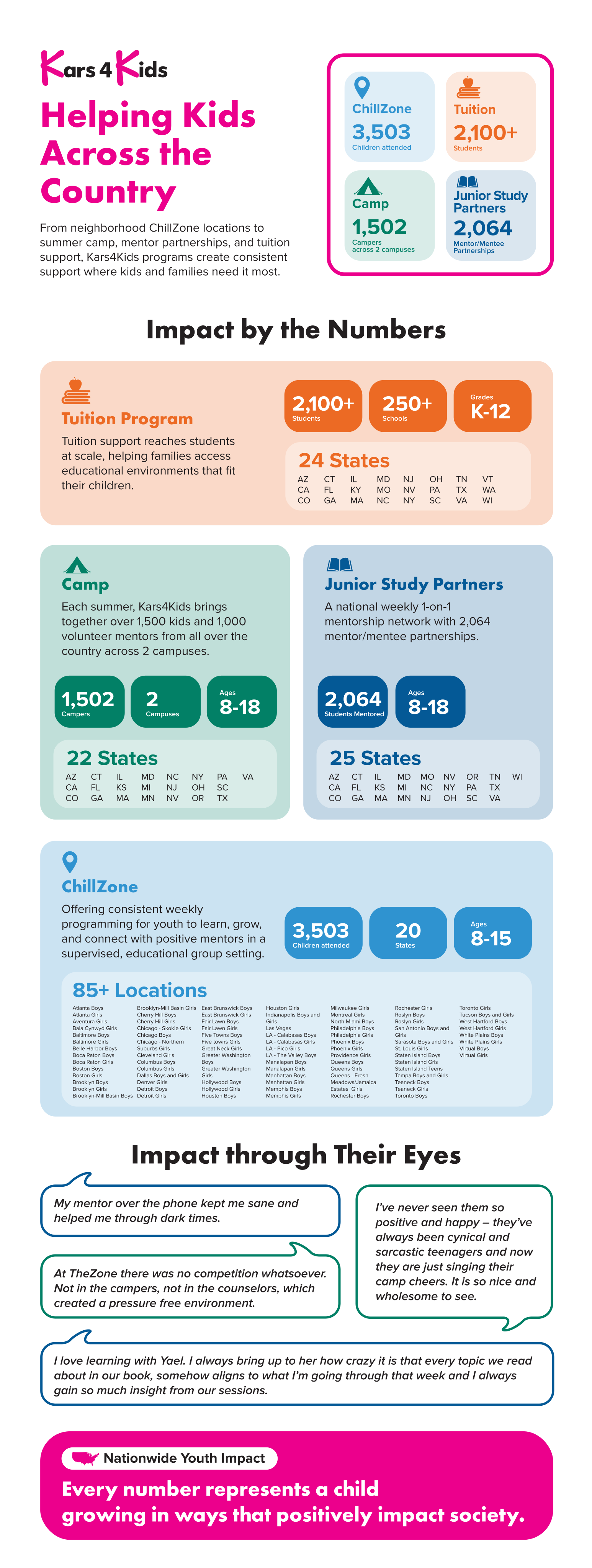
Oorah’s work with children is extensive, and at the heart of its charitable mission. It provides significant financial assistance to approximately 2,200 preschool, elementary, and high school students, ages 5 to 17, attending more than 250 schools across the United States and Canada. It operates free extracurricular programming for children ages 8 to 15 in more than 80 locations in 20 states, with over 3,500 registered participants. Hundreds of boys and girls ages 8 to 17 attend Oorah’s sleepaway camp, TheZone, each summer. Hundreds more children ages 10 to 17 receive free one-on-one mentorship and tutoring through Oorah. These programs serve families from many states beyond New York and New Jersey, including California.
Yet Judge Gassia Apkarian’s decision largely disregarded this evidence. Instead, it highlighted two comparatively small programs as though they defined the organization: one serving approximately 250 students who choose to spend a post-high-school gap year in Israel, and another offering dating guidance and mentorship to marriage-minded program members. Whatever one thinks of those programs, they are ancillary to Oorah’s core work. Treating them as the centerpiece of Kars4Kids’ charitable mission was not analysis; it was distortion.
The decision applies a glaring double standard. Oorah’s programs count when they can be used to make Kars4Kids look foreign, religious, or suspicious. They do not count when they show Kars4Kids funded work serving children and families in California. Gap-year support in Israel and dating guidance are treated as defining evidence of what Kars4Kids does, while Oorah’s work with children in California is minimized or ignored. The result is not a fair assessment of the record. It is selective attribution: using Oorah against Kars4Kids when convenient, and erasing Oorah when it complicates the court’s narrative.
Judge Apkarian made much of the claim that Kars4Kids supposedly had “no functional programs in California,” yet omitted meaningful discussion of Kars4Kids’ own grant program, which provided funding to more than 50 unaffiliated California nonprofits and distributed nearly half a million dollars in grant funds. That program represents only a small percentage of Kars4Kids’ overall charitable budget, but so does the “Middle East outreach” the decision chose to emphasize.
In a politically charged climate of heightened anti-Israel and anti-Jewish sentiment, a decision like this has serious ramifications, lending institutional force and authority to the perpetuation of prejudice.
Mainstream news coverage adopted the decision’s framing: elevating what sounds inflammatory, minimizing what complicates the narrative, and leaving the public with a picture more misleading than any Kars4Kids advertisement ever was.
NBC Bay Area’s coverage of the story is the perfect example: The article says the case began when a donor discovered the money from his donated car “was not going to underprivileged children in California” and then tells readers that instead, “the money landed with an Orthodox Jewish program in New York and New Jersey that sends teenagers on gap year trips to Israel with their families.”
A wave of new media and online commentators continues to amplify the false impression that Oorah is essentially “Birthright + JDate” rather than a broad Jewish youth services organization providing education, mentoring, scholarships, camp, extracurricular programming and family support to thousands of children and families.
For example, The Young Turks characterized the charity as funding “field trips and also adult dating situations for Zionists,” and claimed that donors were told the money was for “young disadvantaged American kids here in this country,” when, in their words, “they weren’t young, they weren’t American, they weren’t disadvantaged, and it wasn’t in this country.” Those statements are not merely inaccurate. They are the natural product of a judicial decision that elevated fringe or ancillary programs, erased the organization’s central work, and invited the public to view a Jewish charity through the most suspicious possible lens.
Updated
Kars4Kids believes the evidence at trial showed the following: Bruce Puterbaugh had an abandoned car on his property. It was left there by someone who had been staying at his house. Title to the car was not in Mr. Puterbaugh’s name. For months, he meant to get rid of the vehicle but never got around to it. Finally, with a party he was hosting around the corner, he had to dispose of it. Kars4Kids offered just what he needed – a quick, free, and easy way to get rid of the car. Mr. Puterbaugh reached out to Kars 4 Kids to have them pick it up.
Pickup went smoothly and Mr. Puterbaugh got exactly what he sought. He ridded himself of the car without any cost. Days later, a neighbor of Mr. Puterbaugh’s, a lawyer, heard of the donation. After Mr. Puterbaugh spoke with the attorney, who shared with Mr. Puterbaugh that Kars 4 Kids is a Jewish charity, this lawsuit began.
After Mr. Puterbaugh brought his complaint to Kars4Kids’ attention, Kars4Kids offered him the car back - it had not yet been sold or junked. With the vehicle returned, Mr. Puterbaugh could donate it to another charity. But he refused to take it. That was not surprising. After all, the car was a hassle he didn’t want. It was unclear what kind of damages he could claim given he was making a charitable donation of a car he neither wanted nor needed.
At trial, Kars4Kids’ COO Esti Landau testified that Kars4Kids efficiently secures and processes donations of vehicles to provide funding for charitable programs run by Kars4Kids’ sister charity Oorah. Those programs include school placement and tuition assistance for Jewish elementary and high school students across the US, subsidized summer camps for kids aged 8-18, youth groups in 80+ locations across the US including in California, personal mentorship, family events and holiday packages. Additionally, Kars4Kids offers small grants to secular nonprofits focused on youth development, mentorship and education as well as public service announcements regarding car and child safety.
Among Oorah’s full suite of year-round programs are two smaller programs specifically addressed in the Court’s opinion: a program providing support to American kids spending a post-high school gap year in Israel and a dating mentorship program for young adults who ‘graduated’ from Oorah’s other programs, helping prepare them for the next stage of their lives. The evidence at trial showed that these are smaller programs of Kars4Kids meant to continue to support children who had been participating in Kars4Kids programs during their school-aged years into their transition to young adulthood.
Mrs. Landau also testified about the nature of Kars4Kids’ advertising. Kars4Kids’ ads have one purpose: to remind listeners that Kars4Kids offers a quick and easy way to dispose of an unused vehicle. The ads are targeted to vehicle owners, not specifically to people considering donating to charity. The ads invite listeners considering donating to contact the organization via phone or web, at which point there is ample opportunity to learn more about the charity work and communities the organization supports before donating. Indeed, Mr. Puterbaugh himself testified that all of the information he claimed he did not know about was readily available when he later looked at Kars4Kids’ website (which viewers are directed to in the advertisements).
We believe the Court’s decision is deeply flawed, ignores and misrepresents the facts that were presented at trial, and misapplies the law. It’s well known that we are a Jewish organization and our website makes it abundantly clear. The Court cited no evidence that demonstrates donors would not make their donations if they knew Jewish children benefit and evidence was presented, which the Court ignored, that donors value the fast and free service and, for those who do care about the donation recipients, those donors would still donate regardless of the recipients’ religious background.
For 30 years, we’ve made it easy to donate an old car to benefit kids and families across the country through our sister charity Oorah. We're helping thousands of kids with youth development, mentoring and educational programs, including hundreds in the state of California, contrary to the judge's complete mischaracterization of our work and of the testimony at trial. Like many youth-serving organizations, helping children often means engaging parents and families as well, and continuing support through young adulthood. This holistic approach allows our programs to be more effective at sustaining lasting impact.
We believe this case was nothing more than a lawyer-driven attempt to siphon off charitable funds for their own gain. We expect to win on appeal because the law and the facts are clearly on our side.
People also ask
Has Kars4Kids won its appeal in California?
On June 4, 2026, the Fourth Appellate District Court of California issued a stay of the lower court's injunction, allowing Kars4Kids to continue airing its jingle and advertisements in California while the full appeal proceeds. The underlying appeal remains pending. Kars4Kids is confident it will prevail.
Is Kars4Kids stopping to advertise in California?
Kars4Kids is pursuing all legal options available, including seeking a stay on the injunction and appealing the ruling. We believe strongly that we will win on appeal because the law and the facts are on our side. We care too much about the thousands of kids we’ve committed to help to just give up now. Sorry, but that jingle’s not going away so fast.
Does Kars4Kids only help Jewish kids?
Kars4Kids is a recognized 501(c)3 Jewish organization with a 30-year track record of charitable impact. Our programs primarily serve Jewish children and families, helping them grow academically, personally, and through their connection to their heritage and values. The kids we reach are as diverse as the Jewish community itself – from secular and unaffiliated families to traditional ones, across the full range of racial and socioeconomic backgrounds.
Beyond our core mission, Kars4Kids supports the broader community through our small-grants program funding local nonprofits, back-to-school giveaways in inner cities, and free educational resources for parents.
Why don't Kars4Kids ads say they help Jewish kids?
The single purpose of Kars4Kids ads is to get the jingle in your head.
Rather than asking for charity handouts, Kars4Kids provides a service to its donors - quick, free and easy vehicle pickup. Our ads appeal to anyone with a car, not specifically people considering donating to charity. They are not designed for quick response but for brand recall. The messaging needs to be simple and memorable to be effective.
So there's virtually no information at all in Kars4Kids' 30 or 60 second radio/TV spots beyond how to get in touch with them to donate. Those who take Kars4Kids up on the invitation to visit their website or who call the number sung in the jingle have ample opportunity to learn more about the programs and communities supported before donating.
Does Kars4Kids fund trips for teens and families to Israel?
Kars4Kids is an apolitical Jewish IRS-recognized organization helping thousands of kids throughout the USA and Canada.
Through our sister charity Oorah, Kars4Kids supports a full suite of year-round youth development, mentoring and educational programs for Jewish kids and families throughout the US, including school placement and tuition assistance, youth groups, summer camps, family events and holiday packages. One of these programs provides support for about 200 American students studying abroad at accredited institutions earning college credits in Israel before returning for college.
Oorah recently purchased a building in Jerusalem to be a home base for students in this program. That's the extent of our involvement with Israel.
How much of Kars4Kids' budget goes towards actually helping kids?
Nonprofits report their financials to the IRS using three buckets to categorize their expenses: program (charity), fundraising (advertising), and admin (overhead). Our numbers vary a bit year to year, but generally we allocate about 60 percent of our expenses to program (primarily through grants to our sister charity Oorah and its full suite of youth and family programs). Less than 10 percent goes to admin, considerably lower than most nonprofits of our size, in large part due to modest executive salaries and a thrifty mindset. The remainder is invested in advertising.
Unlike most charities, Kars4Kids does not raise funds from government grants, major philanthropic gifts or member/alumni dues. We look outside of the nonprofit sector entirely and offer a service to the general public that generates a steady stream of revenue for our charity programs. It’s an inherently inefficient fundraising method because it requires mass market advertising and monetization of donations - but it means that we can expand the funds available for the charity exponentially, pulling in funds that wouldn’t otherwise be given to charity at all.
We take a business-like approach to advertising. Unlike the nonprofit ratings agencies, which look askance at advertising, demanding low budgets to prove efficiency, advertising in the business world is seen as an investment, money well spent in order to achieve profit goals. At Kars4Kids, instead of thinking profit, we think of it as more money for our charitable mission. Our in-house marketing professionals pore over the numbers and sweat the details to keep our advertising spend efficient and effective, as low as it could possibly be without sacrificing growth.
We’re the only charity running a car donation program at this scale in the country. Other charities of our size contract with third party processors who absorb all the costs associated with marketing and processing donations and then cut them a check for a percentage of the proceeds. Simple and efficient, yes. But not nearly as effective. Our unique in-house model means we can keep costs down but that, along with our scrupulous transparency and integrity in financial reporting, makes true comparative analysis near impossible.
Advertising less would raise fewer eyebrows and get us better ratings with charity evaluators. But that would mean leaving money on the table, leaving behind cars that could benefit charity to be hauled straight to the junkyard. And we care too much about the kids we help to let that happen.