TikTok crash test videos are racking up millions of views. It’s easy to see why: they’re dramatic, suspenseful, and engineered for virality. But could these clips also be giving viewers a false sense of security about car safety?
Many of the videos feature real people behind the wheel in dangerous, high-stakes crash scenarios that could potentially end in serious injury or death. And with 21 percent of TikTok’s global audience between the ages of 13 and 17, some parents may wonder what impression these videos leave on young drivers.
Could teens come away believing modern cars are so safe that risky driving isn’t a serious concern? Or worse, could some be tempted to recreate what they see onscreen without understanding the expertise and controlled conditions behind professional crash testing?
Those questions led us to Jennifer Morrison, Mazda’s Director of Vehicle Safety Strategy and a former crash investigator, for her perspective on the growing popularity—and potential risks—of viral crash test videos.
What Viral Crash Test Videos Don’t Show
Kars4Kids: TikTok crash test videos are going viral, often with dramatic reactions and commentary. What do these clips capture—and what do they miss?
Jennifer Morrison: These viral clips can capture the intensity of a crash and give people a visible sense of how much goes into vehicle safety. They often show the moment of impact in a way that is easy to react to and remember.

Mazda Director of Vehicle Safety Strategy
Former crash investigator
What they usually do not show is the larger context. A crash test is a controlled evaluation with specific conditions, not a replay of every real-world crash someone might experience. These videos also tend to skip over the broader safety picture, including crash avoidance technology, vehicle dynamics, restraint systems, driver behavior, and the fact that preventing the crash in the first place is just as important as performing well once a crash happens.
Kars4Kids: These videos often attract a lot of attention online. What can you tell about the audiences who watch them, and how do different groups respond to this kind of content?
Jennifer Morrison: A wide range of people are drawn to this kind of content, and they are often watching it for different reasons. Some are genuinely interested in vehicle safety and want to better understand how cars perform in a crash, while others are reacting more to the visual drama or the side-by-side comparisons that tend to drive engagement online.
Different audiences also tend to take away different things. Parents, for example, may watch these clips through the lens of family safety and use them as one of many inputs when thinking about what makes a vehicle feel safe. Younger viewers may first come across this content in a more casual, social way, but it can still influence what stands out to them over time, including which safety features, vehicles, or brands they begin to associate with protection on the road. Over time, repeated exposure to how certain vehicles or brands are presented in safety conversations can start to shape what people notice and what they may later factor into their own decision-making. That is also why broader third-party evaluations can be helpful. Mazda is the Safest New-Car Brand according to Consumer Reports, a ranking that looks at crash-avoidance features as standard equipment, in addition to strong crashworthiness, braking, handling, and control usability. The broader takeaway from reports like this is that safety is increasingly being evaluated as a combination of protection, crash prevention, and how well a vehicle supports the driver.
Safety technology and vehicle engineering can help reduce risk, but they are not a substitute for attentive, responsible driving.
—Jennifer Morrison, Mazda Director of Vehicle Safety Strategy
Kars4Kids: Some of these videos give the impression that crashes can be recreated or staged for content. Are you seeing any signs of that, and how concerning is it from a safety standpoint?
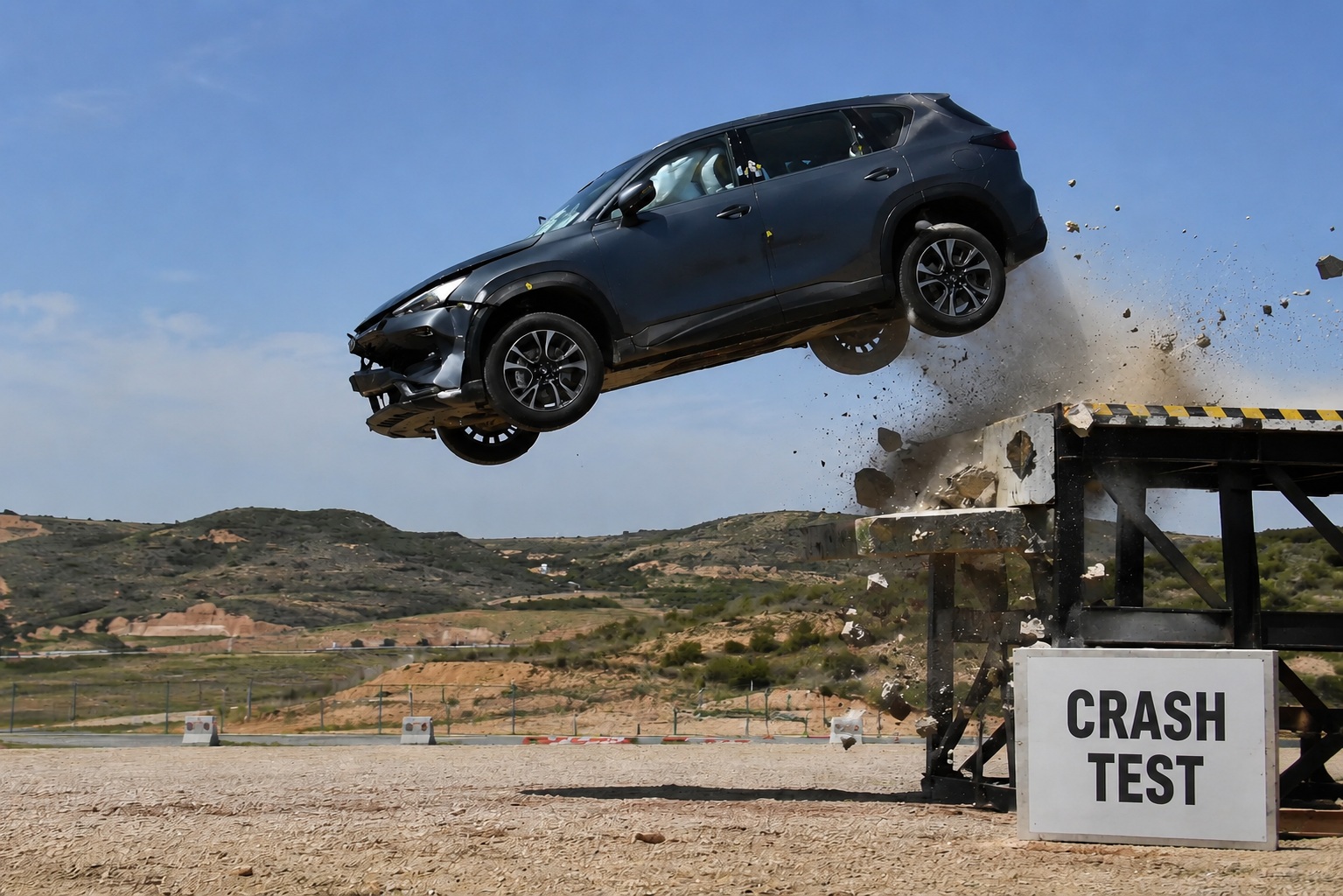
Jennifer Morrison: More broadly, anytime crash-related content is presented in a way that feels easy to recreate, there is potential for the wrong takeaway. Professional crash testing is done in a highly controlled environment, with engineering oversight, safety protocols, and a very specific purpose. That is very different from real-world driving, especially because no one is driving and the vehicle is being pulled down a track by a mechanical pulley system.
From a safety standpoint, the concern is less about any one clip and more about making sure people do not confuse controlled testing with something that can be casually imitated or fully understood through a short video alone. Safety technology and vehicle engineering can help reduce risk, but they are not a substitute for attentive, responsible driving. At the same time, crash test footage can be a fascinating look at the science behind vehicle safety, from seat belt pretensioners helping position the dummies to airbags deploying and helping decelerate them in fractions of a second. That engineering is cool to watch, but it is also a reminder that these systems are designed for protection, not for recreating crashes as content.