
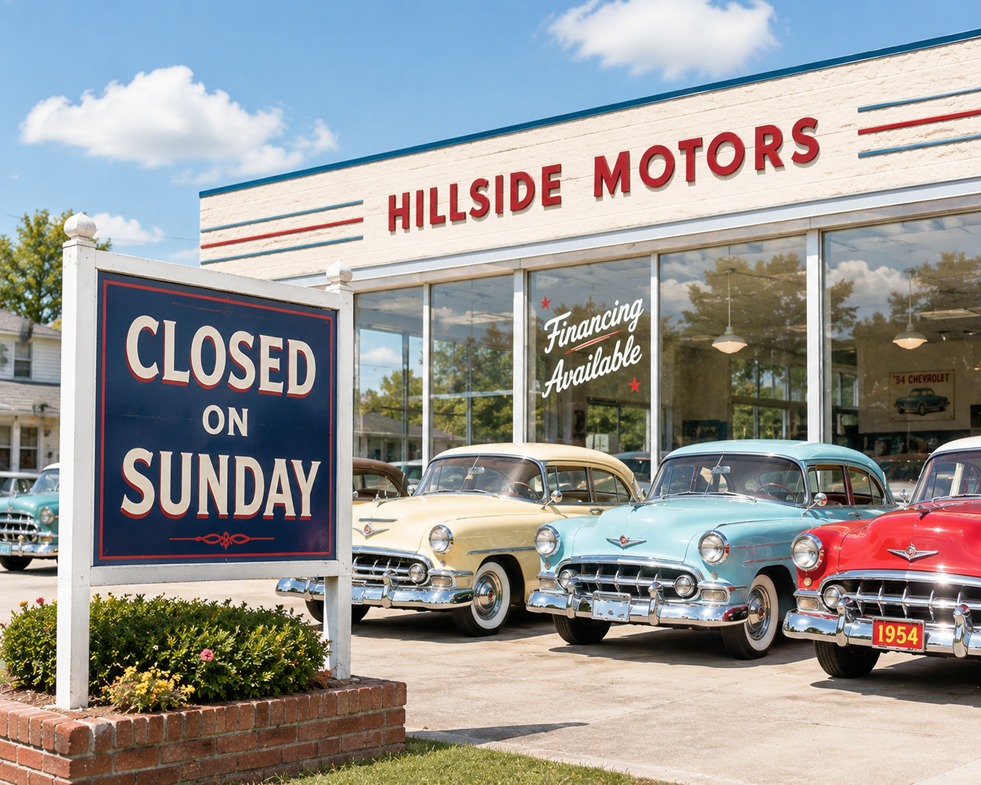
If you’ve ever driven past a car dealership on a Sunday and noticed the lot is dark and the gates are chained, you weren’t imagining things. In 12 states, it’s illegal for a licensed dealer to sell you a car on Sunday. Two more states take a different approach, requiring dealers to close one day every weekend, Saturday or Sunday, their choice. The rest of the country lets dealers decide for themselves.
These are “blue laws” — a category of statute that once regulated all kinds of Sunday commerce and has mostly disappeared, except when it comes to cars.
The 12 states that ban Sunday car sales
Each of these states has a statute currently on the books that prohibits a licensed dealer from selling, buying, bartering, or exchanging a motor vehicle on Sunday. Citations go to the actual code section, not to a summary of it.
| State | Statute | Notable exception |
| Colorado | C.R.S. § 44-20-302 | Boats, boat trailers, snowmobiles, and snowmobile trailers |
| Illinois | 625 ILCS 5, dealer licensing provisions (§§ 5-101, 5-102, 5-106) | Off-site and supplemental-lot sales are barred on Sunday under the same framework |
| Indiana | Ind. Code § 24-4-6-1 | Motorcycles; licensed antique/classic vehicle auctions under a special event permit |
| Iowa | Iowa Code § 322.3(9) | Mobile homes over 8 feet wide or 32 feet long |
| Louisiana | La. R.S. 51:193 | None stated in the statute |
| Maine | 17 M.R.S. § 3203 | Dealers licensed under 29-A M.R.S. § 951 whose primary business is new motor homes (§ 3203-A) |
| Minnesota | Minn. Stat. § 168.275 | Trailers built for watercraft, ATVs, snowmobiles, or general utility use |
| Missouri | Mo. Rev. Stat. § 578.120 | Manufactured housing, RVs, motorcycles, ATVs, personal watercraft, and other powersports vehicles |
| New Jersey | N.J.S.A. 2C:33-26 | Franchised motorcycle dealers, except in counties that have separately voted to prohibit Sunday sales |
| Oklahoma | 21 Okla. Stat. § 918 | Antique, classic, or special-interest automobiles |
| Pennsylvania | 18 Pa. C.S. § 7365 | Licensed motorcycle dealers; manufactured housing |
| Wisconsin | Wis. Stat. § 218.0116(1)(k) | Dealers who observe a Friday-sunset-to-Saturday-sunset Sabbath and refrain from business that day |
A few patterns are worth noting. Several states carve out motorcycles specifically (Indiana, New Jersey, Missouri, Pennsylvania) — nobody seems entirely sure why motorcycles get a pass when cars don’t, though it may simply reflect how much smaller and more fragmented the motorcycle-dealer lobby was when these laws were last updated. Others protect recreational and powersports vehicles (Missouri, Minnesota), manufactured housing (Maine, Missouri, Pennsylvania), or antique and classic cars specifically (Indiana, Oklahoma). Wisconsin’s Sabbath-observer exemption is the only one of its kind among these states — a dealer who closes Friday sundown to Saturday sundown for religious reasons is free to sell cars on Sunday instead.
Two states with a different rule: pick a day, any day
Texas and Utah don’t ban Sunday car sales specifically. Instead, both states prohibit a dealer from selling vehicles on consecutive Saturday and Sunday — meaning a dealership has to pick one day of the weekend to close, but it doesn’t have to be Sunday.
- Texas: Tex. Transp. Code § 728.002 bars selling or offering to sell a motor vehicle on consecutive Saturday and Sunday. Nearly every Texas dealership chooses to close Sunday rather than Saturday, since Saturday tends to be a bigger sales day — but the law itself doesn’t require that choice.
- Utah: Utah Code § 41-3-210(11)(a) imposes the identical rule, with an exception for trade shows involving five or more dealers held away from any participant’s home lot.
In both states, a dealer that ignored the rule and tried to sell cars every day of the weekend would be violating the law regardless of which specific day the sale happened on.
Two states that get listed but shouldn’t be
A lot of the lists circulating online claim 13 or even 14 states ban Sunday car sales. Two of the states that show up most often on those lists don’t hold up against the current law.
North Dakota had a genuinely restrictive set of statewide blue laws — described by the Greater North Dakota Chamber as “the most restrictive in the country” — until they were repealed in 2019. In January 2025, a bill (HB 1150) attempted to bring back a comprehensive Sunday closing law that would have covered vehicle sales among many other goods. It failed on the House floor by a vote of 89 to 4. There is currently no statute banning Sunday car sales in North Dakota.
Mississippi appears on many blue-law roundups, but a review of the state’s Motor Vehicle Commission Law (Miss. Code Title 63, Chapter 17) turns up no Sunday-specific sales prohibition. It’s possible this is simply an old error that keeps getting copied from one article to the next.
If you’re researching this for your own state and see it listed somewhere online, it’s worth checking the actual current statute rather than trusting a summary — as this exercise demonstrated, more than one widely cited list gets it wrong.
Why do these laws survive?
Blue laws banning Sunday commerce were originally about religious observance — giving workers, and specifically retail workers, a mandated day of rest tied to the Christian Sabbath. Courts upheld their constitutionality decades ago on the theory that a uniform day of rest serves a secular purpose even if it originated in religious practice.
Most Sunday commerce bans have since been repealed. Cars are one of the last holdouts, and the reason isn’t really religious anymore — it’s competitive. Car dealerships tend to support keeping these laws in place because they guarantee that no competitor gains an advantage by staying open an extra day. Every dealer gets a mandated day off, employee costs drop, and no one has to worry about losing a sale to the shop down the road that stayed open. Attempts to repeal these laws come up in state legislatures fairly regularly — Colorado’s ban survived a repeal attempt in 2020, Utah’s has been challenged more than once, and Pennsylvania has seen proposed legislation to strike its ban — but none has succeeded so far.
Does this affect private sales?
No. Every one of these statutes targets licensed dealers specifically. A private individual selling their own car to another private party can do so any day of the week, including Sunday, in every state. The practical complications of a Sunday private sale — finding a notary if your state requires one for title transfer, or getting the vehicle registered before your state’s DMV reopens — are logistical, not legal.
Sources: statutory citations above link to the current version of each state code, primarily through official state legislature sites, state revisor’s offices, or Justia’s code database. Where a statute’s plain text didn’t specify particular details, the relevant licensing regulation or agency guidance is cited instead.