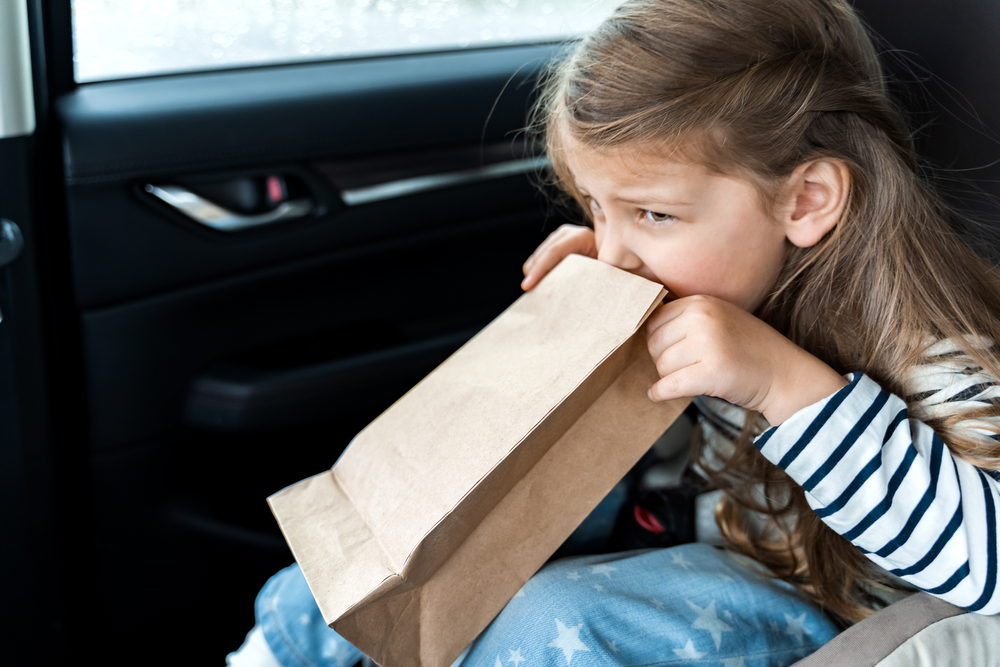
“Mommy, I feel sick,” are the last words a parent wants to hear when driving with a child in tow. If your child has a tendency to get car sick, you know how it goes. There’s a quiet feeling of desperation. Will you be able to pull over in time before they “sick” all over your car? The smell of vomit never really comes out, no matter how much you clean the upholstery.
Plus, you know car sickness or “motion sickness” as it’s officially called, isn’t serious. Sure you feel sorry for your child, and it’s worrying when you see them pale and white-lipped. At the same time, it’s something that will definitely blow over. Just hopefully not in the literal sense—because vomit in a car is not fun to deal with.
Of course, motion sickness happens other places, too. Which is why “motion sickness” is a more accurate term than “car sickness.” Kids (and adults) can get sick in airplanes, trains, amusement park rides, and even on the swings at the local playground. In short, motion sickness happens. And unfortunately, so does vomit. When you hear your child say, “Mommy, I feel sick,” take them seriously.
Summer Travel and Motion Sickness
So with summer coming up, you may be wondering what you can do to prevent or at least minimize symptoms of car or motion sickness in your child. Family road trips or airplane rides to visit relatives or exotic destinations are not fun when you’ve got to deal with a child who gets car sick. There’s the parent’s legitimate concern that their child feels unwell. But it’s also legitimate to feel a certain level of anxiety knowing that at any given moment, your child just may toss their cookies. On you, on their siblings, on your car, in a train or plane (which is embarrassing, as well).
It’s common for children to experience motion sickness. The symptoms of car sickness can include nausea, dizziness, cold sweats, and yes, vomiting. Car sickness is caused by a heightened sensitivity of the inner ear. When children ride in a car, for example, the brain receives certain signals that are triggered by movement. These signals come from the eyes, inner ears, muscles, and joints. When the signals don’t match up, the result is motion sickness.
Let’s say your child is riding in a car while reading. Their inner ear senses motion, but the eyes are involved with reading a book, a stationary object. The child is looking down at the book but his inner ear senses the motion of the car. This can cause mixed signals to the brain, which in turn, can lead to nausea.
Preventing Car Sickness
Kids tend to inherit car sickness. That means it’s not something they can control by willing it away. But there are steps parents can take to prevent or lessen the effects of car sickness.
- Children under the age of 13, should sit in the middle backseat when traveling in cars or other vehicles. Direct your child to look straight ahead, out the front window, rather than through the side window, to avoid mixed signals to the brain.
- In a plane, it helps to take the seat that’s above the wings, or at the center of the aircraft, where turbulence is less of a problem for passengers.
- Urge your child to avoid reading, watching movies, or playing with hand-held games when traveling by car. It’s better to have your child listen to audiotapes or play car games such as “I spy,” a game which requires them to look out the window.
- During road trips, keep the window cracked open to get fresh air circulating in the car.
- Have a bag handy, in case your child needs to vomit.
- Children who are prone to car sickness should eat lightly before traveling. Crackers and water are a good choice. Have the child stay away from heavy, greasy food until you reach your destination.
- At amusement parks, stick to rides that don’t involve any spinning.
- Ask your child’s pediatrician about anti-nausea medication. Such medications may prevent or lessen the symptoms of motion sickness, and some are formulated especially for children.
Motion Sickness Isn’t Serious
Parents may dread hearing that phrase, “Mommy, I feel sick.” They can, however, rest assured that motion sickness is unconnected to any physical disease. Once you arrive at your destinations, the symptoms tend to go away within four hours. Should your child become ill during travel, have him keep a bag handy in case he needs to vomit. Limit drinks to sips of clear fluids, until the child’s tummy settles.